Affiliate Disclaimer: This article contains affiliate links. If you buy through them, we may earn a small commission at no extra cost to you. Our recommendations are based on research, product specifications and feedback from verified buyers, and we only include products we think are worth considering. As an Amazon Associate we earn from qualifying purchases.
Are you actually in ketosis, or just eating fewer carbs? Cravings, energy and the scale give you hints, but only a test gives you a number. Picking the best ketone meter comes down to three questions: how accurate it needs to be, how often you will test, and what each test costs you in strips.
This guide compares blood meters, urine strips and breath analyzers side by side, explains what your readings mean, and includes a free calculator that turns a glucose and ketone reading into your Glucose Ketone Index (GKI) with a plain-English explanation.
Quick picks: the best ketone meters at a glance
- Best overall: Keto-Mojo GK+. Measures blood ketones and blood glucose, syncs over Bluetooth and the app calculates your GKI.
- Best established alternative: Abbott Precision Xtra. Reads blood glucose and blood ketones on one meter, without an app or automatic GKI.
- Cheapest way to start: Ketostix urine strips. Low cost per test and no needles, but unreliable for mild ketosis.
- No strips at all: a breath ketone analyzer. A one-time purchase that shows trends, less precise than blood.
Blood, urine or breath: what each test really measures
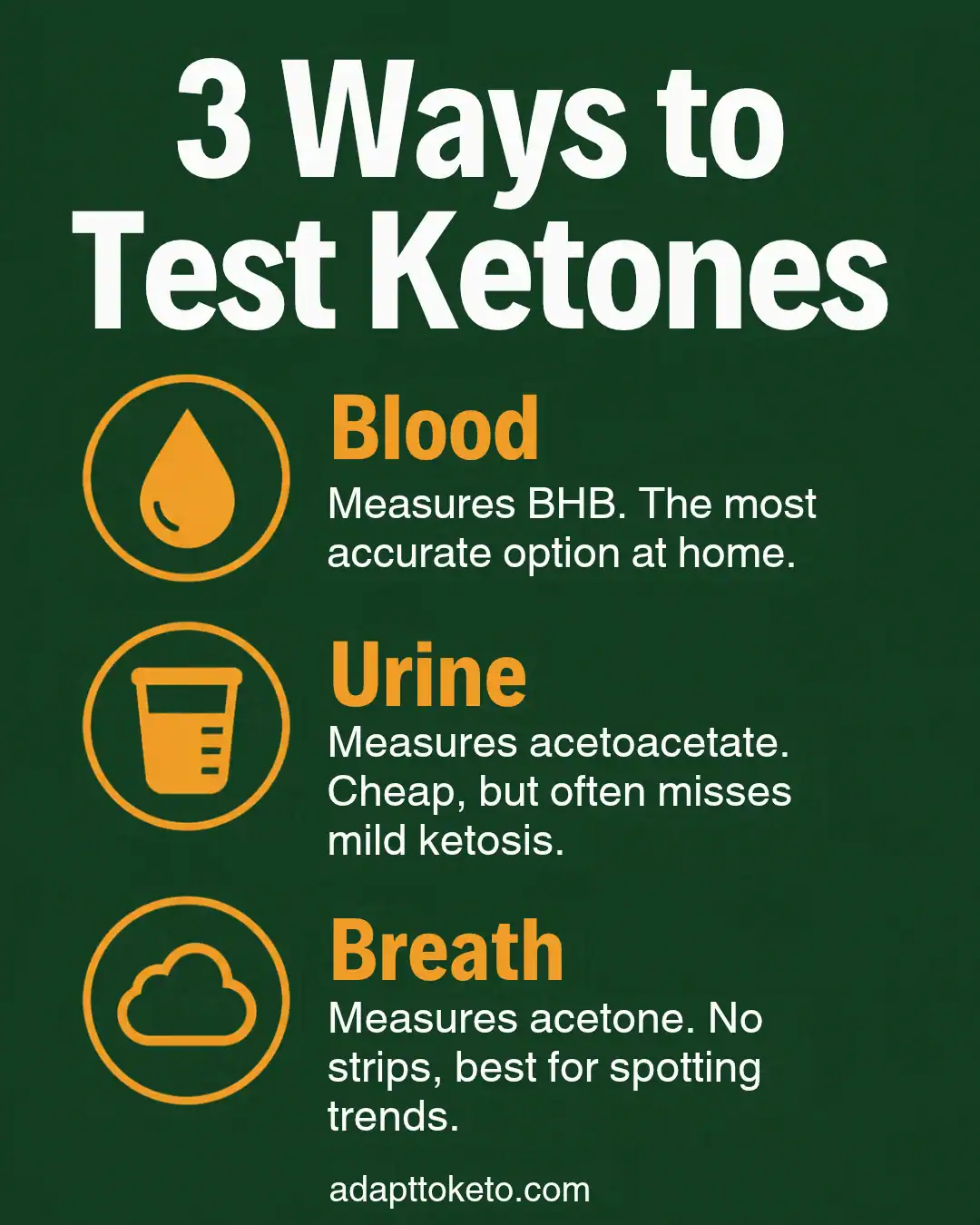
Your liver makes three ketone bodies, and each home test measures a different one (Suntrup et al., PeerJ, 2020). That is why results from different methods do not always agree.
- Blood meters measure beta-hydroxybutyrate (BHB), the main ketone circulating in your blood. A fingerstick and a single-use strip give a number in mmol/L.
- Urine strips measure acetoacetate, the ketone your body excretes when it has more than it uses. The strip changes color within seconds.
- Breath analyzers measure acetone, a small ketone you breathe out. The device is reusable and needs no strips.
Blood BHB is the reference method home tests are compared against. In a 2020 study, researchers treated blood BHB as the gold standard when they evaluated a breath acetone meter, while noting that fingerstick meters can differ from laboratory plasma values by about 0.2 mmol/L (Suntrup et al., PeerJ, 2020).
Why urine strips miss mild ketosis
Urine strips are cheap and easy, but the evidence on accuracy is not encouraging. In a study of 50 women on a very low energy diet, researchers compared 263 urine samples with blood BHB measured at the same time. Urine strips detected only 52 percent of the readings at or above 0.5 mmol/L, the usual threshold for nutritional ketosis, and 76 percent at or above 1.0 mmol/L. The authors concluded that urine dipsticks are not an accurate or clinically useful way to detect mild ketosis (Gibson et al., Obesity Science and Practice, 2020).
How breath compares with blood
Breath acetone tracks blood ketones, but loosely. In a 14-day study with 19 participants, a breath acetone meter showed a moderate point-by-point correlation with blood BHB (R squared 0.57), and a stronger one when whole days were compared (0.80). Blood BHB usually peaked about four hours before breath acetone. The study was funded by the meter manufacturer, and results from one device do not automatically apply to others (Suntrup et al., PeerJ, 2020).
Ketone test methods compared
| Method | What it measures | Accuracy for nutritional ketosis | Ongoing cost per test | Best for |
|---|---|---|---|---|
| Blood meter | BHB in blood (mmol/L) | Highest of the home options | A strip for every test, two strips for GKI | Accurate tracking, GKI, medical keto under supervision |
| Urine strips | Acetoacetate in urine | Low, often misses mild ketosis | Lowest per test | A cheap first check in week one |
| Breath analyzer | Acetone in breath | Moderate, best for trends | None after buying the device | Frequent checks without needles |
We do not list prices because they change often. A blood meter costs the most per test because every reading uses a strip, and a GKI reading needs a glucose strip and a ketone strip. Check strip prices before you choose a meter.
Free ketone reading interpreter and GKI calculator
Enter a blood glucose reading (in mg/dL or mmol/L) and a blood ketone reading taken at the same time. The calculator shows your Glucose Ketone Index, places your ketone level in a range and explains what the numbers mean. If you have diabetes, take related medication, have kidney disease, are pregnant or have warning symptoms, it shows a see-your-doctor message instead of numbers.
Ketone Reading Interpreter and GKI Calculator
Loading the calculatorEnter a blood glucose reading and a blood ketone (BHB) reading taken at the same time. You get your Glucose Ketone Index (GKI) and a plain-English explanation of what both numbers mean.
Your GKI
0
Glucose in mmol/L divided by ketones in mmol/L
Ketone level
0
0
Glucose
0
0
What your numbers mean
For general information only, for adults without medical conditions. Ketone bands follow published guidance for nutritional ketosis; the GKI formula comes from Meidenbauer and colleagues (2015). There is no validated GKI target for weight loss. This is not a diagnostic tool.
The best ketone meters and testers in detail
1. Keto-Mojo GK+: best overall
The GK+ is Keto-Mojo’s current meter for the US and Canada. According to the manufacturer it measures blood ketones from 0.1 to 8.0 mmol/L with a result in about 10 seconds, and blood glucose from 10 to 700 mg/dL in about 5 seconds. It stores 1,000 readings and runs on two AAA batteries (Keto-Mojo specifications). Built-in Bluetooth syncs readings to the free MyMojoHealth app, and the GK+ needs no code key (Keto-Mojo trade-up page).
The meter itself does not show your GKI on screen. When it is connected to the app, the app calculates and displays it for you. Keto-Mojo also states that the GK+ is FDA cleared for at-home blood glucose self-monitoring. Keep in mind that it only works with Keto-Mojo GK+ strips: the brown glucose strips and teal ketone strips are not interchangeable with each other or with strips for other Keto-Mojo models (Keto-Mojo product FAQ).
How accurate is it? A small 2021 study with 13 healthy adults compared a Keto-Mojo meter with Abbott’s Precision Xtra. Ketone readings agreed closely (intraclass correlation 0.968), and the Keto-Mojo correctly identified nutritional ketosis at or above 0.5 mmol/L in about 9 out of 10 cases. Glucose agreement was good but less tight, and the authors did not recommend it for precise glucose measurement in keto-adapted athletes. Neither meter was compared with laboratory testing (Moore et al., Journal of the International Society of Sports Nutrition, 2021).
- Pros: measures ketones and glucose, Bluetooth app with GKI, no code key, large memory
- Cons: every reading uses a strip, GK+ strips only fit the GK+
Read more in our Keto-Mojo GK meter review.
2. Abbott Precision Xtra: best established alternative
The Precision Xtra from Abbott is a long-standing meter that reads blood glucose and blood ketones (BHB) on one device, using separate Precision Xtra glucose strips and ketone strips. According to Abbott, glucose results take about 5 seconds and ketone results about 10 seconds. The meter stores 450 readings with date and time, needs no coding and has a large backlit display. Results can be downloaded to a computer with a data cable that is sold separately (Abbott Store).
It is also the meter the Keto-Mojo was compared against in the 2021 study above, where ketone readings from both devices agreed closely (Moore et al., 2021). The main difference for keto users is convenience: there is no Bluetooth app and no automatic GKI, so you work out your GKI yourself, for example with the calculator above. Check the price of the ketone strips before you buy, because every ketone reading uses one.
- Pros: measures glucose and ketones, no coding, large backlit display, 450-reading memory
- Cons: no Bluetooth app or automatic GKI, data cable sold separately, every reading uses a strip
3. Ketostix urine strips: cheapest way to start
Ketostix are reagent strips that test urine for acetoacetic acid. According to the package insert, you read the strip at exactly 15 seconds against a color chart that runs from negative through trace (5 mg/dL), small (15 mg/dL) and moderate (40 mg/dL) to large (80 to 160 mg/dL). A bottle can be used for six months after it is first opened, as long as the cap stays tightly closed (Ketostix package insert, Ascensia).
Strips are a reasonable way to see whether anything is happening in your first week of keto. Just remember the study above: a negative or trace result does not prove you are out of ketosis.
- Pros: lowest cost per test, no needles, no device to buy
- Cons: often misses mild ketosis, color reading is subjective, limited shelf life after opening
4. Breath ketone analyzer: no strips, good for trends
Breath analyzers are reusable devices that estimate acetone in your breath. Once you own the device, testing costs nothing and needs no fingerstick.
The trade-off is precision. As the 2020 study showed, breath acetone follows blood ketones with a delay of hours and only a moderate correlation for single readings. Quality also varies a lot between models, so look for a device with clear specifications, a replaceable or self-calibrating sensor, and consistent feedback from verified buyers about readings that track with blood tests.
What your blood ketone reading means
Virta Health, a provider of medically supervised ketogenic care, uses these bands for blood BHB in people on a well-formulated ketogenic diet (Virta Health):
- 0.0 to 0.3 mmol/L: not in nutritional ketosis
- 0.4 mmol/L: borderline
- 0.5 to 3.0 mmol/L: the range usually described as nutritional ketosis
- Above 3.0 mmol/L: a deeper level of ketosis that can follow extended fasting, low protein intake, illness or dehydration (Virta Health)
Higher is not automatically better. Phinney and Volek note that nutritional ketosis typically produces blood ketones of about 0.5 to 2 mmol/L (Phinney and Volek, Virta Health). If you want to understand why your numbers change as you adapt, read our article on ketosis vs fat adaptation.
What is the Glucose Ketone Index (GKI)?
The GKI is a single number that combines your blood glucose and blood ketones: glucose in mmol/L divided by ketones in mmol/L. If your meter shows glucose in mg/dL, divide it by 18 first. It was introduced by researchers studying ketogenic therapy for brain cancer, who suggested that values between 1 and 2 represent the zone for metabolic management, with values approaching 1.0 potentially most therapeutic (Meidenbauer et al., Nutrition and Metabolism, 2015).
That context matters. The GKI was designed for supervised medical therapy, and there is no validated GKI target for weight loss or general health. Keto-Mojo suggests testing 2 to 3 hours after a meal, ideally twice a day, if you want to track your GKI (Keto-Mojo).
How to choose the best ketone meter for you
- Accuracy you need. For a quick yes or no in week one, urine strips can do. For reliable numbers, choose a blood meter.
- Cost per test. Estimate how often you will test. Daily blood testing adds up, a breath analyzer has no ongoing cost.
- Glucose too? A meter that measures both lets you calculate your GKI and see how meals affect your blood sugar.
- Strip availability. Strips are model-specific. Make sure they are easy to buy where you live.
- App and memory. Bluetooth syncing makes it far easier to spot trends than writing readings down.
Tips for accurate readings
- Wash and dry your hands before every fingerstick.
- Test at the same time of day, for example fasted in the morning or 2 to 3 hours after a meal.
- Use the right strips for your meter and check the expiry date.
- Read urine strips at the stated time, 15 seconds for Ketostix, and ignore color changes after that.
- Look at trends, not single numbers. One reading can be off. A week of readings tells you much more.
Common mistakes
- Chasing high ketones. A higher number does not mean faster fat loss.
- Quitting because a urine strip is pale. Urine strips often miss mild ketosis.
- Comparing different methods. Blood, breath and urine measure different ketones on different timelines.
New to keto? Our guide on how long it takes to get keto adapted explains what to expect in the first weeks.
When to see a doctor
Talk to a doctor before testing and following keto if you have diabetes or take medication for diabetes, blood pressure or a heart condition, if you have kidney disease, or if you are pregnant or breastfeeding. For people with diabetes, NHS guidance treats blood ketones under 0.6 mmol/L as normal and above 1.5 mmol/L as a risk of diabetic ketoacidosis, and advises going to an emergency department straight away with any ketone level if you are vomiting, have stomach pain or feel drowsy (NHS Scotland, My Diabetes My Way). Some diabetes drugs (SGLT2 inhibitors) can cause ketoacidosis even when blood sugar is not high (diaTribe on the FDA safety statement). Get medical help right away if you have nausea or vomiting, stomach pain, extreme thirst, fast breathing or confusion, whatever your meter says.
Final verdict
For most people the Keto-Mojo GK+ is the best ketone meter for home testing: it measures blood ketones and glucose, syncs to an app that calculates your GKI, and blood BHB is the most accurate home method. Urine strips are a cheap first check but often miss mild ketosis, and a breath analyzer is a good way to follow trends without buying strips. Use the calculator above to make sense of your readings, and focus on how you feel and how your numbers trend over weeks.
Related articles
- Keto-Mojo GK Meter Review
- Ketosis vs Fat Adaptation
- How Long Does It Take to Get Keto Adapted?
- How to Get into Keto
- Keto Macro Calculator
FAQ
Question: What is the most accurate way to test ketones at home?
Answer: A blood ketone meter. It measures BHB directly, and blood BHB is the reference that urine and breath tests are compared against.
Question: What ketone level means I am in ketosis?
Answer: About 0.5 mmol/L of blood BHB or higher is generally considered nutritional ketosis. Readings of 0.5 to 3.0 mmol/L are common on a well-formulated ketogenic diet.
Question: Can I use any strips in my Keto-Mojo meter?
Answer: No. Keto-Mojo meters only work with Keto-Mojo strips for that specific model, and glucose and ketone strips are not interchangeable.
Question: Why does my urine strip show nothing when my blood meter says I am in ketosis?
Answer: Urine strips measure acetoacetate in urine, not BHB in blood. In research they missed about half of blood readings at or above 0.5 mmol/L, so a pale strip does not mean you are out of ketosis.
Question: How often should I test my ketones?
Answer: There is no fixed rule. Testing more often in the first weeks and less once you know how your body responds keeps strip costs down. Test at the same time of day so readings are comparable.
Question: Is a low GKI always better?
Answer: No. The GKI target of 1 to 2 comes from research on supervised ketogenic therapy for brain cancer. There is no proven GKI goal for weight loss or general health.
This article is for general information and does not replace advice from your doctor or dietitian.