Affiliate Disclaimer: This article contains affiliate links. If you buy through them, we may earn a small commission at no extra cost to you. Our recommendations are based on research, product specifications and feedback from verified buyers, and we only include products we think are worth considering. As an Amazon Associate we earn from qualifying purchases.
You flip a keto bar over, see 23 grams of carbohydrate on the label, and the wrapper on the front says 4 grams. Both numbers can be correct. The difference is fiber and sugar alcohols, and knowing how to calculate net carbs properly is what keeps you from either overcounting healthy foods or undercounting a sweet treat that quietly pushes you out of your daily limit.
This guide explains what total carbs and net carbs are, why US and European labels need different math, how to treat each sugar alcohol, and when counting total carbs is the smarter choice. Further down you will find a free net carb calculator: type in the numbers from any nutrition label and it does the counting for you.
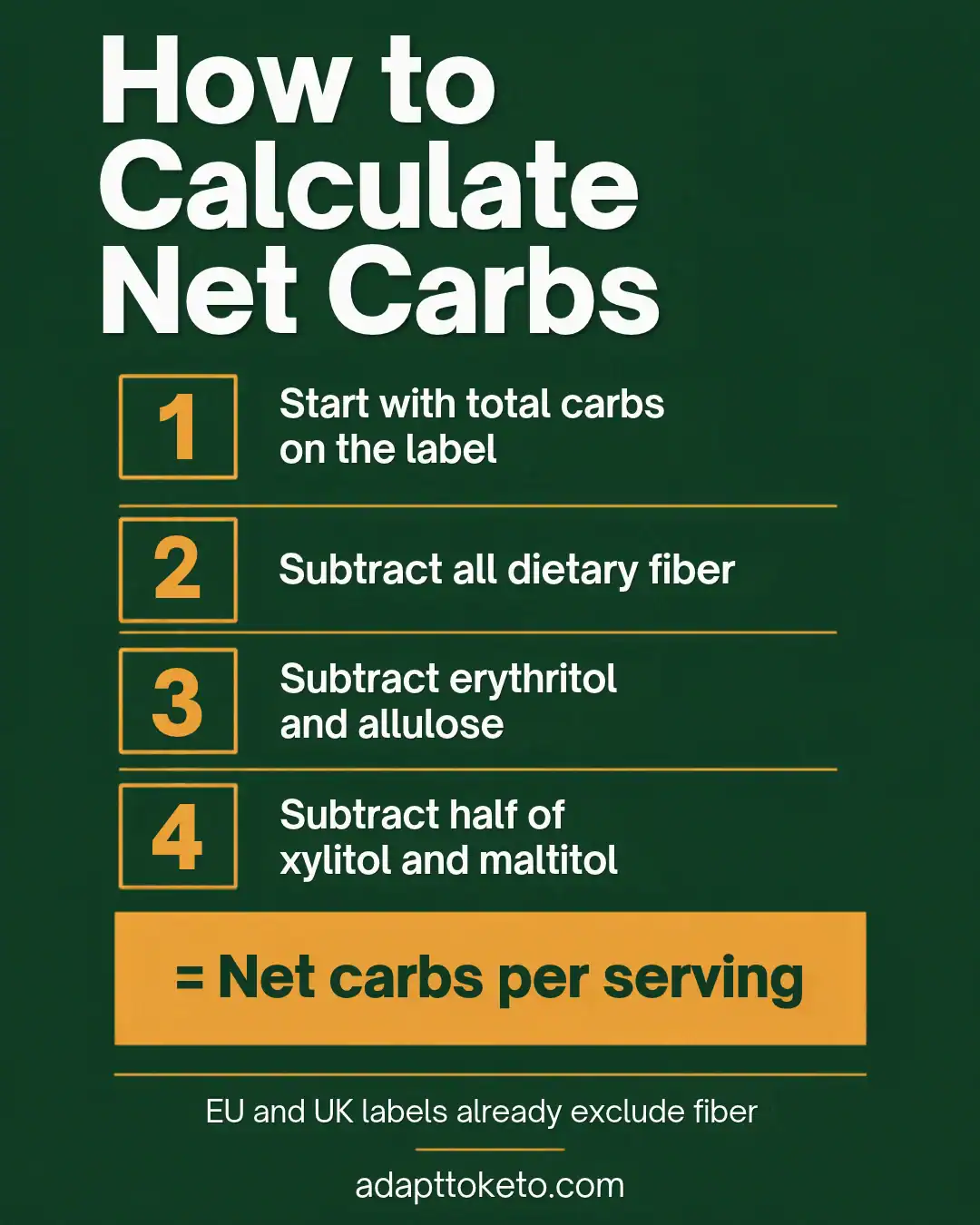
Quick answer: the net carb formula
- Start with total carbohydrate for one serving on the label.
- Subtract all dietary fiber (only on US style labels, see below).
- Subtract erythritol and allulose in full. They have little or no effect on blood sugar.
- Subtract half of other sugar alcohols such as xylitol and maltitol, because part of them is absorbed.
- Multiply by the servings you actually eat. This step is where most counting errors happen.
Total carbs vs net carbs: what is the difference?
Total carbohydrate is the official number on the label. On a US Nutrition Facts label it includes three groups: sugars, dietary fiber and sugar alcohols (FDA). Fiber resists digestion in the small intestine, and sugar alcohols are only partly absorbed, so neither behaves like the sugar and starch in bread or rice.
Net carbs is the part that remains after you take out the carbohydrates that have little effect on your blood sugar. It is a useful idea, but it is not an official term: the FDA has no legal definition for net carbs, and the American Diabetes Association does not use it (diaTribe). That means the net carb figure printed on the front of a package is the manufacturer’s own calculation. Always check it against the Nutrition Facts panel.
US labels vs EU and UK labels
This one trips up a lot of people. The word “carbohydrate” does not mean the same thing on both sides of the Atlantic.
- US labels: total carbohydrate includes fiber. You subtract fiber to get net carbs.
- EU and UK labels: carbohydrate is defined as any carbohydrate that is metabolised by humans, including polyols (sugar alcohols). Fiber is defined separately as carbohydrate that is neither digested nor absorbed, so it is already left out of the carbohydrate figure (Regulation (EU) No 1169/2011, Annex I).
So if you subtract fiber from a European label, you subtract it twice and end up with a number that is too low. On an EU or UK label, you only subtract the sugar alcohols. Our calculator below has a switch for exactly this.
How to count each sugar alcohol
Sugar alcohols (polyols) are not all equal. A widely cited review in Nutrition Research Reviews measured their glycemic index (GI) against glucose at 100 and sucrose at 65: erythritol scored 0, xylitol 13, sorbitol 9, isomalt 9 and maltitol 35 (Livesey, 2003). That spread explains why keto guides treat them differently.
| Sweetener | Glycemic index | Common keto counting |
|---|---|---|
| Erythritol | 0 | Subtract in full |
| Allulose | Not a sugar alcohol; FDA allows 0.4 kcal per gram | Subtract in full |
| Xylitol | 13 | Subtract half |
| Sorbitol, isomalt | 9 | Subtract half |
| Maltitol | 35 | Subtract half, or count it fully to be safe |
| Unspecified “sugar alcohols” | Unknown mix | Subtract half |
Erythritol
Up to about 90% of the erythritol you eat is absorbed in the small intestine and then passed in urine, largely unchanged; in one study 84% of a 25 gram dose was recovered from urine (Arrigoni et al., British Journal of Nutrition, 2005). With a GI of 0, subtracting it in full is reasonable. One caution: a 2023 study in Nature Medicine linked higher blood erythritol levels to more heart attacks and strokes in people already at high cardiovascular risk. It was an observational study that cannot prove cause, and controlled trials in healthy people have not shown harm, but it is a reason to use erythritol in normal amounts rather than by the cupful (Pafili and Roden, 2023).
Allulose
Allulose is a rare sugar rather than a sugar alcohol. The FDA allows manufacturers to leave it out of total and added sugars and to count it at 0.4 calories per gram instead of 4, but it must still be included in total carbohydrate (FDA). So a product sweetened with allulose can show 0 grams of sugar and still list a high total carb number. Check the ingredient list for allulose and subtract that amount.
Xylitol
Xylitol has a low GI but is partly absorbed, so most keto guides subtract half. It is also the same rule many diabetes educators use for sugar alcohols in general: subtract half of the grams of sugar alcohol from total carbohydrate (UCSF Diabetes Teaching Center). If you have a dog, keep xylitol products out of reach: in dogs it can cause a dangerous drop in blood sugar (FDA). More in our guide on how to use xylitol on a ketogenic diet.
Maltitol
Maltitol is the one to watch. With a GI of 35 it raises blood sugar noticeably more than the others, and it is common in “sugar free” chocolate and candy. Subtracting half is the usual rule, but if a product’s net carbs only look low because of maltitol, many keto dieters prefer to count it in full. Large amounts can also cause bloating and diarrhea.
Calculate your net carbs with our free tool
Choose your label type, copy the numbers for one serving and enter how many servings you eat. The calculator shows the net carbs per serving, for your portion, and how much of your daily limit that is. Use the strict method if you want to count xylitol, maltitol and other sugar alcohols in full. If you use insulin or take medication for diabetes or blood pressure, the tool asks you to check with your doctor first instead of giving a number.
Net Carb Calculator
Loading the calculatorCopy the numbers from one serving on the nutrition label. The calculator subtracts fiber and each sugar alcohol the way most keto guides do, and shows how much of your daily carb limit the portion uses.
Net carbs per serving
0 g
From the label
For your portion
0 g
0% of your daily limit
Carbs subtracted
0 g
Per serving, fiber plus sugar alcohols
How we counted it
What this means
Net carbs are an estimate, not a value defined by the FDA. Sugar alcohols affect people differently, and some products do not list each one separately. If you count total carbs instead, your result is simply the total on the label.
A worked example
Take a typical low carb bar with this US label per bar: total carbohydrate 23 g, dietary fiber 14 g and sugar alcohols 9 g, of which 5 g erythritol and 4 g xylitol according to the label.
- 23 g total minus 14 g fiber = 9 g
- Minus 5 g erythritol = 4 g
- Minus half of 4 g xylitol (2 g) = 2 g net carbs per bar
With the strict method the xylitol counts in full and you land at 4 g. Eat two bars and it is 4 to 8 g, which is a fifth to two fifths of a 20 g daily limit. The same bar sold in Europe would show about 9 g of carbohydrate (fiber already removed), and you would only subtract the sugar alcohols.
Should you count net carbs or total carbs?
Both approaches are used. Most keto apps and recipes use net carbs, often with a limit of around 20 to 30 grams a day. Some clinical programs count total carbs instead. Virta Health, for example, suggests many people start at no more than about 30 grams of total carbohydrate a day and adjust from there, and notes that most people with type 2 diabetes need to stay below 50 grams a day (Virta Health).
A practical way to choose:
- Net carbs work well if most of your carbs come from vegetables, nuts, seeds and avocado. They reward high fiber whole foods.
- Total carbs are simpler and more conservative. They make sense if you eat a lot of packaged keto products, if your weight loss has stalled, or if your doctor or diabetes team asks you to.
Not sure what your daily target should be? Start with our keto macro calculator.
Tools that make carb counting easier
You do not need to buy anything to count carbs. A free app and the labels in your kitchen are enough to start. These are the tools many keto beginners find useful, based on manufacturer specifications and what verified buyers commonly report.
Etekcity digital food scale
Serving sizes on labels are only useful if you know how much you actually eat. Etekcity lists its EKS-C302 kitchen scale with a capacity of 5 kg (11 lb), readings in 1 g or 0.05 oz steps, and units in grams, ounces and millilitres (Etekcity). Buyers commonly mention its small footprint and easy tare button. Several Etekcity models are sold on Amazon, so compare the precision you need: 1 g steps are fine for meals, 0.1 g models suit spices and baking.
The Complete Book of Food Counts
Corinne T. Netzer’s pocket guide is a long running reference for the nutrition content of foods, now in its 9th edition (Penguin Random House). It is handy for whole foods and for people who prefer not to log everything in an app. Brand name products change their recipes over time, so check packaged foods against the current label.
Lakanto Monkfruit Sweetener (Classic)
Lakanto Classic is made from erythritol and monk fruit extract and is sold as a 1:1 sugar replacement; the manufacturer describes it as zero net carbs and zero glycemic (Lakanto). It is also a good example of why label reading matters: because the bulk is erythritol, the grams show up under total carbohydrate and sugar alcohols on a US label, and you subtract them to get to zero net carbs.
How to read a label in 30 seconds
- Check where the label is from. US style “Total Carbohydrate” or EU and UK style “Carbohydrate”.
- Check the serving size and how many servings are in the pack.
- Find fiber and sugar alcohols. On US labels, sugar alcohols are listed under total carbohydrate when the manufacturer declares them.
- Scan the ingredient list for erythritol, allulose, xylitol and maltitol, so you know which sugar alcohol you are subtracting.
- Do the math yourself instead of trusting the net carb claim on the front.
Common net carb mistakes
- Subtracting fiber twice on European labels. EU and UK carbohydrate figures already exclude fiber.
- Treating maltitol like erythritol. Maltitol has a much higher glycemic index.
- Ignoring the serving size. A bag of keto snacks with “2 g net carbs” may contain four servings.
- Trusting front of pack claims. Net carbs is not a regulated term, so the method varies by brand.
- Letting “keto” products crowd out vegetables. Low net carbs do not automatically mean a nutritious food. Many keto beginners also find that bread swaps help, see our list of low carb bread brands.
When to see a doctor
Talk to a doctor before starting keto or changing how you count carbs if you use insulin or take medication for diabetes, blood pressure or a heart condition, if you have kidney disease, or if you are pregnant or breastfeeding. Cutting carbs can lower blood sugar and blood pressure quickly, and medication doses may need to change. If you dose insulin by carbs, follow your diabetes team’s advice on whether to use total or net carbs. Get medical help right away if you have very high blood sugar readings, vomiting that will not stop, confusion, extreme thirst or trouble breathing.
Final verdict
Net carbs are total carbohydrate minus fiber and the sugar alcohols your body barely uses. On a US label, subtract fiber, erythritol and allulose in full and half of xylitol, maltitol and other sugar alcohols. On an EU or UK label, leave fiber alone because it is already excluded. Multiply by what you actually eat, and do your own math rather than trusting the front of the pack. Use the calculator above whenever a label looks too good to be true, and a kitchen scale to make sure your portions match the serving size.
Related articles
- Keto Macro Calculator
- How to Use Xylitol in a Ketogenic Diet
- Low-Carb Bread Brands for Keto Dieters
- The Ultimate Keto Shopping List for Beginners
- How to Get into Keto
FAQ
Question: Is net carbs the same as total carbs minus fiber?
Answer: On a US label that is the starting point. If the food contains sugar alcohols or allulose, you subtract those too, either in full (erythritol, allulose) or by half (xylitol, maltitol and most others).
Question: Do I subtract fiber on a UK or European label?
Answer: No. Under EU rules, and the UK’s retained version of the same regulation, the carbohydrate figure already excludes fiber. Only subtract sugar alcohols.
Question: Why does my keto snack say 0 g sugar but 15 g carbs?
Answer: It probably contains fiber, sugar alcohols or allulose. Allulose and sugar alcohols are not counted as sugar on US labels, but they are part of total carbohydrate.
Question: How many net carbs can I eat and stay in ketosis?
Answer: It varies. Many people aim for 20 to 30 g of net carbs a day, and clinical programs often work with total carbs below 30 to 50 g. A blood ketone meter is the most reliable way to see where your own limit is.
Question: Is counting net carbs safe if I have diabetes?
Answer: Talk to your doctor or diabetes team first. If you use insulin, they will tell you whether to dose on total or net carbs, and your medication may need adjusting on a low carb diet.
This article is for general information and does not replace advice from your doctor or dietitian.