Affiliate Disclaimer: This article contains affiliate links. If you buy through them, we may earn a small commission at no extra cost to you. Our recommendations are based on research, product specifications and feedback from verified buyers, and we only include products we think are worth considering. As an Amazon Associate we earn from qualifying purchases.
Giving up sugar is one of the first things you do on keto, and it is also one of the first things you miss. Coffee, a weekend bake, a sauce that needs a little sweetness: they all need something. The shelves are full of options, but they are not interchangeable. Some measure cup for cup like sugar, some need more, some come in drops, and a few have quirks you only find out about halfway through a recipe. This guide helps you pick the best keto sweetener for what you actually make.
We compare five popular products on what they are made of, how they swap for sugar, how they count toward net carbs and where they work best. Further down you will find a free converter that tells you exactly how much of each sweetener to use for any amount of sugar, with the net carbs per batch and per serving.
Quick picks: the best keto sweetener for each job
- Best all-rounder: Lakanto Classic Monkfruit Sweetener. A 1:1 sugar swap based on erythritol and monk fruit extract.
- Best for classic baking recipes: Swerve Granular. Measures cup for cup and is available in granular and confectioners versions.
- Best for caramel, sauces and soft bakes: Wholesome Allulose. Tastes close to sugar and does not count toward sugars on the label.
- Best for drinks: SweetLeaf Stevia Sweet Drops. A few drops sweeten coffee, tea or yogurt with no carbs.
- Best erythritol-free 1:1 option: BochaSweet. Made from kabocha squash extract, but keep it away from dogs (more below).
How keto sweeteners differ
Keto sweeteners fall into two groups, and knowing which group you are dealing with explains most baking surprises.
High-intensity sweeteners such as stevia and monk fruit extract are used in tiny amounts. Food Standards Australia New Zealand puts steviol glycosides at roughly 150 to 300 times the sweetness of sugar and monk fruit extract at roughly 250 to 400 times (FSANZ). In the US, the FDA has not objected to the GRAS status of highly purified steviol glycosides and monk fruit extracts, while whole-leaf and crude stevia extracts are not permitted as sweeteners (FDA). Because so little is needed, they add sweetness but no bulk.
Bulk sweeteners such as erythritol and allulose are used in amounts close to sugar, so they give cookies and cakes their structure. Erythritol is a sugar alcohol that is about 60 to 80 percent as sweet as sugar. Most of it is not metabolized and leaves the body unchanged in urine, and it does not raise blood glucose or insulin (Regnat et al., Applied Microbiology and Biotechnology). Allulose is a rare sugar that is roughly 70 percent as sweet as sugar (University Hospitals).
Most sweeteners sold as a 1:1 sugar replacement are blends: a bulk sweetener for volume plus a high-intensity extract to bring the sweetness up to the level of sugar. That is why “monk fruit sweetener” on the front of a bag usually means erythritol with a little monk fruit extract.
How they count toward net carbs
Erythritol and allulose show up under total carbohydrate on a Nutrition Facts label. Most keto followers subtract them completely, because erythritol is excreted unchanged and allulose is not used as fuel in the way sugar is. The FDA allows brands to leave allulose out of total and added sugars and to count it at 0.4 calories per gram (FDA guidance on allulose). Our guide to net carbs vs total carbs explains how to read these labels.
Keto sweeteners compared
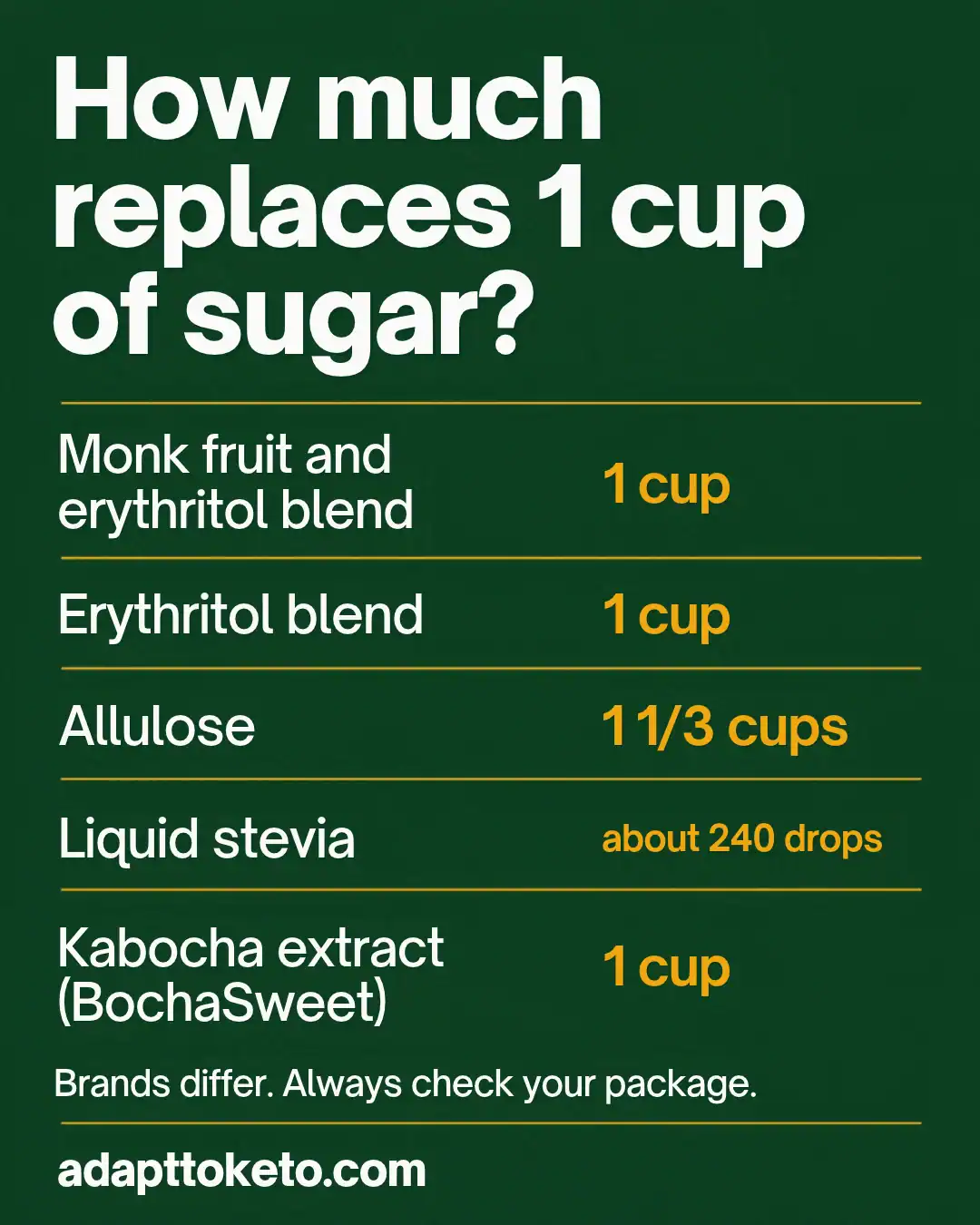
| Sweetener | Main ingredients | Swap for 1 cup of sugar | Net carbs (label method) | Best for | Watch out for |
|---|---|---|---|---|---|
| Lakanto Classic | Erythritol, monk fruit extract | 1 cup | 0 g | Everyday baking, coffee | Cooling aftertaste, can recrystallize |
| Swerve Granular | Erythritol, oligosaccharides, natural flavors | 1 cup | 0 g | Cakes, cookies, frosting (confectioners) | Oligosaccharides may bother sensitive guts |
| Wholesome Allulose | Allulose | 1 1/3 cups | 0 g | Caramel, sauces, ice cream, soft bakes | Browns quickly, large amounts can cause bloating |
| SweetLeaf Sweet Drops | Stevia leaf extract (liquid) | About 240 drops | 0 g | Coffee, tea, yogurt, dressings | No bulk, bitter if overused |
| BochaSweet | Kabocha squash extract | 1 cup | Check the package | Erythritol-free 1:1 baking | Xylitol structure, keep away from dogs |
Sources for the swap ratios: Lakanto and Swerve state a 1:1 swap, Wholesome lists 1 1/3 cups of allulose for 1 cup of sugar (product listing), SweetLeaf states 15 drops for 1 tablespoon of sugar (SweetLeaf conversion chart), which works out to about 240 drops per cup, and BochaSweet is sold as a 1:1 replacement (product listing).
Convert any recipe with our free sweetener calculator
Enter the amount of sugar in your recipe in cups, tablespoons, teaspoons or grams, pick a sweetener and set the number of servings. The converter shows how much to use, how many grams of sugar carbs you replace and the net carbs from the sweetener per batch and per serving. If you tick one of the boxes under “Check before you start”, it shows a see-your-doctor message instead of numbers.
Keto Sweetener Converter
Loading the converterEnter the amount of sugar in your recipe, pick a sweetener and the number of servings. You get the amount to use, the carbs you save and the net carbs per batch and per serving.
Use this much
0
Measured like sugar
Sugar carbs you replace
0
Table sugar is almost pure carbohydrate
Net carbs per batch
0
From the sweetener only
Net carbs per serving
0
From the sweetener only
Good to know about this sweetener
Conversions follow the manufacturers’ own sugar equivalents and label serving sizes (1 cup of sugar counted as 200 g). Results are estimates for home cooking, not medical or nutrition advice. Sweetness perception varies, so taste and adjust.
The best keto sweeteners in detail
1. Lakanto Classic Monkfruit Sweetener: best all-rounder
Lakanto Classic combines erythritol with monk fruit extract and is sold as a 1:1 replacement for white sugar. A 2 teaspoon serving lists 8 g of carbohydrate, all of it as sugar alcohol, and 0 calories (Open Food Facts label data), which is why it is usually counted as zero net carbs. It works in coffee, cookies, muffins and most recipes that call for white sugar.
Verified buyers mostly praise the taste and the easy 1:1 swap. The most common complaint is the cooling sensation typical of erythritol. Lakanto also sells powdered and golden versions.
2. Swerve Granular: best for classic baking
Swerve is made from erythritol, oligosaccharides and natural flavors and measures cup for cup like sugar (Healthline). The label lists 4 g of carbohydrate per teaspoon, all as sugar alcohol. It is a favorite for cakes and cookies because it behaves predictably in recipes written for sugar, and the confectioners version makes smooth frosting and glazes.
Buyers often say the aftertaste is mild, though the cooling effect shows in large amounts. People with IBS or a sensitive gut may want to start small because of the oligosaccharides.
3. Wholesome Allulose: best for caramel, sauces and soft bakes
Wholesome Allulose contains a single ingredient: allulose. It is less sweet than sugar, so the brand advises 1 1/3 cups for every cup of sugar. A 2 teaspoon serving lists 9 g of total carbohydrate and 0 g of total and added sugars (product listing). Allulose does not raise blood sugar or insulin according to University Hospitals, although human research on its long-term effects is still limited and large amounts can cause gas and bloating (University Hospitals).
Because allulose does not recrystallize the way erythritol can, buyers like it for caramel, ice cream, sauces and soft cookies. A common tip from reviewers is that it browns faster than sugar, so check bakes early and lower the oven slightly or cover with foil if needed.
4. SweetLeaf Stevia Sweet Drops: best for drinks
SweetLeaf Sweet Drops are a liquid stevia extract. According to SweetLeaf, 15 drops replace 1 tablespoon of sugar (SweetLeaf). They are convenient for coffee, tea, smoothies, yogurt and salad dressings, and they come in many flavors such as vanilla and chocolate.
Drops do not add bulk, so they are not a direct swap for sugar in cakes or cookies. Buyers often combine a few drops with a granular sweetener to cut the amount of erythritol or allulose. Too much stevia can taste bitter, so start low and add to taste.
5. BochaSweet: best erythritol-free 1:1 option
BochaSweet is made from kabocha squash extract and is sold as a 1:1 sugar replacement with zero glycemic impact. Retail listings describe it as “kabocha extract in xylitol structure” (product listing). It is an option for people who dislike the cooling effect of erythritol or want to avoid it.
Because it is marketed with a xylitol structure, we recommend treating BochaSweet exactly like xylitol in a home with dogs. Net carb information varies between listings, so use the numbers on your own package. Buyers often say it tastes very close to sugar and works well in baking.
What about the erythritol and heart health study?
In 2023, researchers from the Cleveland Clinic reported that people with higher blood levels of erythritol had a higher risk of heart attack, stroke or death over three years. The pattern was seen in more than 4,000 people across three groups in the US and Europe, most of whom already had heart risk factors. In the lab, erythritol made platelets more reactive, and in a small pilot with 8 healthy volunteers a drink with erythritol raised blood levels for more than two days (Witkowski et al., Nature Medicine, 2023).
These are associations, not proof that erythritol from food causes heart problems. The body also makes erythritol on its own, and the authors say long-term safety studies are needed. If you have heart disease, diabetes or a history of blood clots, it is reasonable to discuss erythritol with your doctor and to consider allulose, stevia or monk fruit drops instead.
Keep xylitol away from dogs
Xylitol is a common sugar alcohol in sugar-free gum, nut butters and some sweetener blends. It is fine for most people in moderate amounts, but it is dangerous for dogs. The FDA warns that in dogs xylitol can cause a rapid, severe drop in blood sugar within 10 to 60 minutes, with signs such as vomiting, weakness, stumbling, collapse and seizures (FDA). If your dog eats anything with xylitol, call your vet or an animal poison control center right away. Read more in our article on how to use xylitol in a ketogenic diet.
How to choose the right keto sweetener
- Decide what you make most. Drinks: drops. Cookies and cakes: a 1:1 granular blend. Caramel, ice cream and sauces: allulose.
- Read the ingredient list, not just the front. “Monk fruit sweetener” is usually mostly erythritol. Some cheaper blends add maltodextrin or dextrose, which do count as carbs.
- Check the swap ratio. 1:1 blends are easiest. Allulose needs about a third more. Drops need a conversion chart or our calculator.
- Think about your gut. Sugar alcohols and oligosaccharides can cause gas or loose stools in larger amounts. Start with small portions.
- Consider pets. In a home with dogs, avoid xylitol and xylitol-type products or store them out of reach.
Common mistakes and baking tips
- Swapping drops for sugar in a cake. Without bulk, the batter will be dry and dense. Use a granular sweetener or a recipe written for liquid stevia.
- Using the same amount of allulose as sugar. The result tastes less sweet. Use about 1 1/3 times the amount.
- Expecting erythritol to stay smooth in sauces. It can recrystallize as it cools. Allulose or a powdered blend works better.
- Overdoing it at once. Large servings of sugar alcohols are a common cause of bloating. Spread treats over the week.
- Forgetting the rest of the recipe. A zero-carb sweetener does not make a recipe keto if the flour or fruit is high in carbs. Track the full recipe with our keto macro calculator.
Looking for something to bake? Our keto desserts with minimal ingredients are a good place to try a new sweetener.
When to see a doctor
Talk to a doctor or dietitian first if you take insulin or other medication for diabetes, blood pressure or a heart condition, if you have kidney disease, or if you are pregnant or breastfeeding. Switching to keto and sugar-free sweeteners can change your blood sugar quickly, and medication doses may need adjusting. Get medical help if you have severe stomach pain, blood in your stool, diarrhea that lasts more than two days, or signs of low blood sugar such as shaking, sweating and confusion.
Final verdict
There is no single best keto sweetener for everything. For most people, a 1:1 monk fruit and erythritol blend such as Lakanto Classic or Swerve is the easiest everyday choice. Allulose is the better pick for caramel, sauces and anything that should stay soft, and stevia drops are hard to beat in coffee and tea. If you want to avoid erythritol, allulose, stevia drops and BochaSweet are the alternatives, but treat BochaSweet like xylitol around dogs. Use the converter above whenever you adapt a recipe.
Related articles
- How to Use Xylitol in a Ketogenic Diet
- Keto Desserts with Minimal Ingredients
- Net Carbs vs Total Carbs: How to Count Them Right
- Keto Macro Calculator
- The Ultimate Keto Shopping List for Beginners
FAQ
Question: What is the best keto sweetener for baking?
Answer: For most recipes written for sugar, a 1:1 erythritol blend such as Lakanto Classic or Swerve Granular is the easiest swap. For caramel, sauces and soft cookies, allulose usually gives a better texture.
Question: Does monk fruit sweetener kick you out of ketosis?
Answer: Pure monk fruit extract and blends with erythritol are usually counted as zero net carbs. Check the ingredient list for added maltodextrin or dextrose, which do add carbs.
Question: Is allulose better than erythritol?
Answer: Neither is better for everything. Allulose tastes closer to sugar and does not recrystallize, but it browns faster and is less sweet. Erythritol blends measure 1:1 like sugar, but some people dislike the cooling aftertaste.
Question: How much stevia equals 1 cup of sugar?
Answer: It depends on the product. For SweetLeaf Sweet Drops the brand states 15 drops per tablespoon of sugar, which is about 240 drops per cup. Our converter does the math for any amount.
Question: Can keto sweeteners upset your stomach?
Answer: Yes, especially sugar alcohols and oligosaccharides in larger amounts. Start with small portions and spread sweet treats over the week.
Question: Are keto sweeteners safe for dogs?
Answer: Xylitol is toxic to dogs and can cause a dangerous drop in blood sugar. Treat xylitol-type products such as BochaSweet the same way and keep all sweeteners out of reach of pets.
This article is for general information and does not replace advice from your doctor or dietitian.