Affiliate Disclaimer: This article contains affiliate links. If you buy through them, we may earn a small commission at no extra cost to you. Our recommendations are based on research, product specifications and feedback from verified buyers, and we only include products we think are worth considering. As an Amazon Associate we earn from qualifying purchases.
Standing in the supermarket wondering whether carrots, cashews or Greek yogurt still fit your plan? You are not alone. Keto is simple on paper, but the details trip up almost everyone in the first few weeks. A clear keto food list takes the guesswork out of shopping, cooking and eating out.
This guide sorts common foods into three groups: eat freely, eat in moderation and skip. You will see typical net carbs per serving, the foods that surprise people most, and a free Is It Keto? checker further down that lets you search more than 150 foods and get a green, amber or red verdict based on your own daily carb limit.
Quick answer: what to eat and what to skip
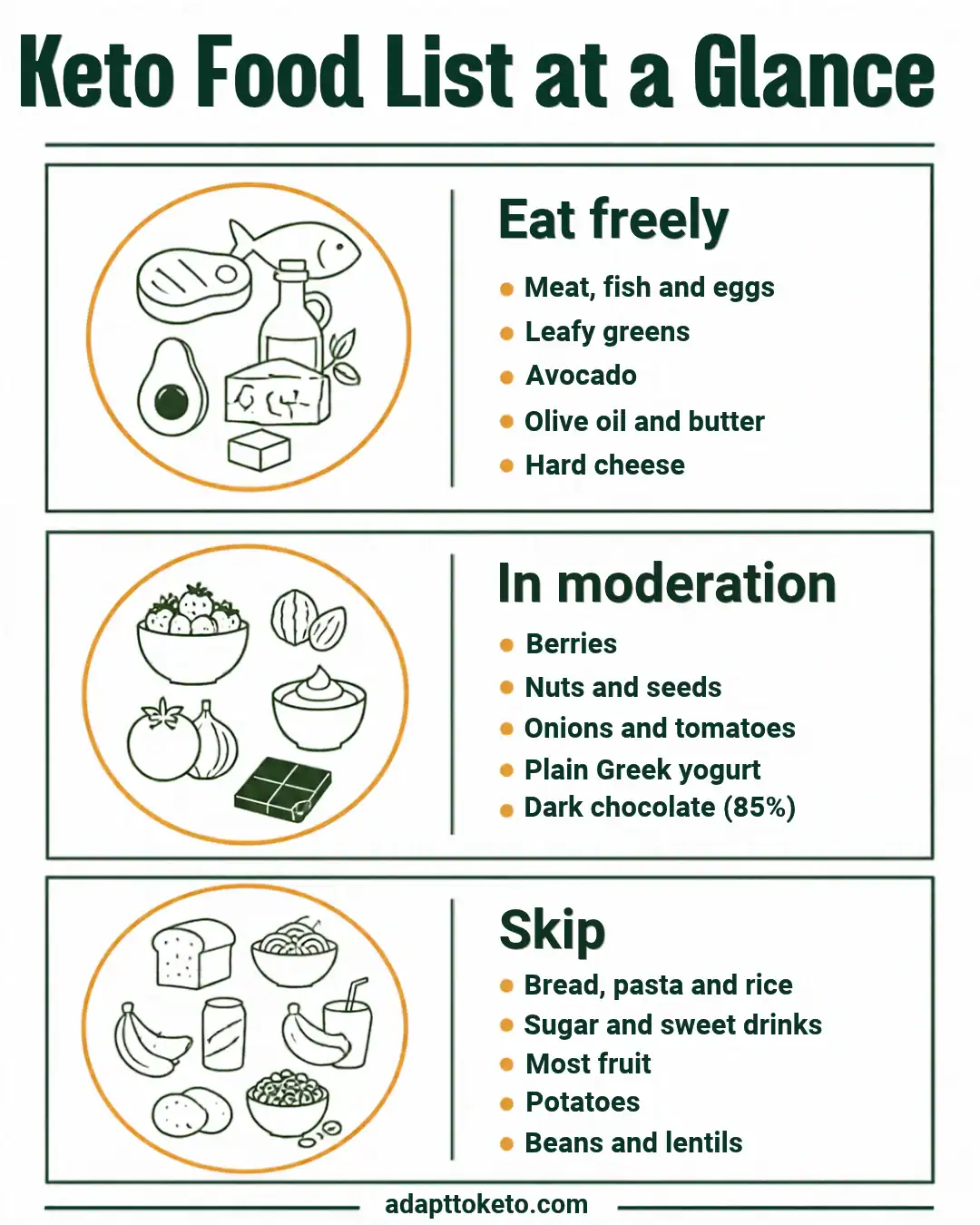
- Eat freely: meat, fish, eggs, hard cheese, butter, olive oil, avocado and leafy greens.
- Eat in moderation: berries, nuts and seeds, onions, tomatoes, plain Greek yogurt and very dark chocolate.
- Skip or keep rare: bread, pasta, rice, cereal, sugar, sweet drinks, most fruit, potatoes, corn, beans and lentils.
- Swap smart: almond or coconut flour for wheat flour, cauliflower rice for rice, lettuce wraps or low carb tortillas for bread.
How many carbs can you eat on keto?
A ketogenic diet typically keeps total carbohydrate below 50 grams a day, and some plans go as low as 20 grams (Harvard T.H. Chan School of Public Health, The Nutrition Source). Virta Health, a clinic that uses ketogenic nutrition with patients, notes that most people need to stay under 50 grams a day to reach nutritional ketosis, and that around 30 grams is a safer target if you want to be sure (Virta Health).
Most keto followers count net carbs: total carbohydrate minus fiber. Fiber is not digested into glucose, so foods like avocado and leafy greens count for far less than their label suggests. A 100 gram portion of raw avocado, for example, contains about 8.5 grams of carbohydrate, of which 6.7 grams is fiber (USDA FoodData Central). Not sure how to read a label? Our guide on how to calculate net carbs walks you through it, and the keto macro calculator helps you set your own daily limit.
The keto food list at a glance
| Food | Typical serving | Approx. net carbs | Verdict |
|---|---|---|---|
| Salmon, beef, chicken, eggs | 4 oz or 1 egg | 0 to 0.5 g | Eat freely |
| Cheddar cheese | 1 oz | 0.4 g | Eat freely |
| Spinach, raw | 1 cup | 0.4 g | Eat freely |
| Avocado | 1/2 medium | 1.2 g | Eat freely |
| Broccoli | 1 cup chopped | 3.7 g | Moderate portions |
| Almonds | 1 oz | 2.6 g | Moderate portions |
| Raspberries | 1/2 cup | 3.4 g | Moderate portions |
| Plain Greek yogurt, whole milk | 3/4 cup | 6.6 g | Small portions |
| Blueberries | 1/2 cup | 8.9 g | Small portions |
| Apple | 1 medium | about 21 g | Skip |
| Potato, baked | 1 medium | about 33 g | Skip |
| White rice, cooked | 1 cup | about 44 g | Skip |
Check any food with our free Is It Keto? checker
Type a food or pick a food group, choose your daily net carb limit and the number of servings. The checker shows the net carbs, the share of your daily limit and a simple verdict. Green means a serving uses up to 10 percent of your limit, amber up to 30 percent, and red more than that. If you take medication for diabetes, blood pressure or your heart, have kidney disease or are pregnant, it asks you to speak with your doctor first instead of showing numbers.
Is It Keto? Food Checker
Loading the checkerType a food or pick a group. You see the net carbs per serving and a green, amber or red verdict based on your own daily net carb limit.
Values are approximate net carbs (total carbs minus fiber) per typical serving, rounded from USDA FoodData Central data. Brands, varieties and portion sizes differ, so check the label of what you buy. Green means up to 10 percent of your daily limit per serving, amber up to 30 percent, red more than that. This is general information, not medical advice.
Foods to eat freely
Meat, fish and eggs
Unprocessed meat, poultry, fish and eggs contain little to no carbohydrate, which makes them the backbone of most keto meals. Fatty fish such as salmon, mackerel and sardines also add omega 3 fats. Keep an eye on processed meats: some sausages, deli meats and meatballs contain added sugar, starch or breadcrumbs. Shellfish like mussels and oysters contain a few grams of carbs per serving, so count them rather than eating them without limit (Medical News Today).
Healthy fats and oils
Olive oil, avocado oil, butter, ghee and coconut oil contain no carbs. Harvard’s Nutrition Source notes that a well planned keto diet can emphasize unsaturated fats from oils, nuts, seeds and avocado rather than relying mostly on saturated fat (The Nutrition Source). Mayonnaise is also carb free in most cases, but many supermarket brands use soybean or canola oil. If you prefer an avocado oil version, Primal Kitchen Mayo is made with avocado oil, organic eggs and vinegar, with no cane sugar according to the manufacturer (Primal Kitchen).
MCT oil is a popular addition to coffee or salad dressings. Sports Research Organic MCT Oil, for example, is sourced from organic coconut oil and contains C8 and C10 fatty acids, and the brand suggests starting with one teaspoon a day before working up to a tablespoon (Sports Research). Starting slowly matters: large doses of MCT oil are a common cause of stomach upset. Read more in our comparison of collagen vs MCT oil.
Non-starchy vegetables
Leafy greens, zucchini, cauliflower, broccoli, asparagus, mushrooms, cabbage and celery are your main source of fiber, potassium and many vitamins on keto. Most non-starchy vegetables are allowed on a ketogenic diet (The Nutrition Source). Leafy greens are so low in net carbs that you can pile them on. Broccoli, cauliflower and Brussels sprouts still fit well, but at 3 to 5 grams per cup they do add up if you eat several cups a day.
Cheese, butter and cream
Hard and aged cheeses such as cheddar, parmesan and brie contain less than one gram of carbs per ounce. Butter and heavy cream are close to zero in normal amounts. Milk is a different story: one cup of whole milk contains about 12 grams of carbs from lactose, so most keto followers switch to a splash of cream or an unsweetened almond drink.
Foods to eat in moderation
- Berries: raspberries and blackberries have about 3 grams of net carbs per half cup, strawberries a bit more, blueberries around 9 grams. Small portions of berries are allowed on keto, while most other fruit is restricted (The Nutrition Source).
- Nuts and seeds: pecans, macadamias and Brazil nuts are lowest in net carbs, almonds and walnuts are in the middle, and cashews and pistachios are highest. They are also easy to overeat, so portion them out instead of eating from the bag.
- Onions, tomatoes and carrots: fine as flavor in a recipe, but they carry more carbs than leafy greens.
- Plain Greek yogurt and cottage cheese: high in protein, but a full bowl can use a quarter of a strict daily limit. Always choose plain, unsweetened versions.
- Dark chocolate: one or two squares of 85 percent chocolate can fit; milk chocolate does not.
- Dry wine and spirits: a glass of dry wine has a few grams of carbs, but alcohol can slow fat burning and lower your guard around food.
Foods to skip on keto
These foods are high enough in carbohydrate that a single normal serving can use most or all of your daily allowance. Harvard’s review of the ketogenic diet lists all whole and refined grains and flour products, starchy vegetables such as potatoes, corn and winter squash, legumes including beans, lentils and peanuts, fruit juices and most fruit as foods that are restricted (The Nutrition Source).
- Grains and flour products: bread, pasta, rice, oats, cereal, crackers and tortillas. One cup of cooked white rice contains around 44 grams of net carbs.
- Sugar in every form: table sugar, honey, maple syrup, regular soda, sweet coffee drinks and most candy.
- Most fruit: bananas, apples, grapes, mango, pineapple and dried fruit such as dates and raisins.
- Starchy vegetables: potatoes, sweet potatoes, corn, peas and butternut squash.
- Beans and lentils: nutritious, but a half cup of black beans or chickpeas has well over 10 grams of net carbs. Edamame and tofu are the lower carb exceptions.
- Sweet sauces: ketchup, barbecue sauce and many salad dressings contain added sugar. Mustard, hot sauce and full fat dressings without sugar are safer picks.
Smart keto swaps for your favorite carbs
You do not have to give up every comfort food. A few pantry staples make most classic dishes possible on keto.
Almond flour instead of wheat flour
Almond flour works well for pancakes, muffins, breading and pizza bases. Blue Diamond Almond Flour is made from one ingredient, blanched almonds, and lists 5 grams of total carbohydrate and 3 grams of fiber per quarter cup, which is about 2 grams of net carbs (Blue Diamond). It is finely sifted, which buyers commonly mention gives a lighter texture than coarse almond meal.
Coconut flour for baking
Coconut flour is very high in fiber and absorbs a lot of liquid, so recipes use much less of it than almond flour and usually more eggs. Bob’s Red Mill Organic Coconut Flour lists 9 grams of carbohydrate and 5 grams of fiber per 2 tablespoon serving, about 4 grams net, and is labeled gluten free (product label via iHerb). Do not swap it one to one for almond flour; follow a recipe written for coconut flour.
More easy swaps
- Cauliflower rice or shirataki noodles instead of rice and pasta. See our list of keto-friendly alternatives to rice.
- Lettuce wraps or a low carb bread instead of regular bread. Compare options in low-carb bread brands for keto dieters.
- Zucchini noodles instead of spaghetti.
- A keto friendly sweetener instead of sugar. Our guide on using xylitol on keto explains one common option.
How to build your own keto shopping list
- Start with protein. Plan one main protein per meal: eggs, fish, chicken, beef, pork or tofu.
- Add two vegetables per meal. Choose mostly leafy greens and other non-starchy vegetables.
- Pick your fats. Olive oil for salads, butter or avocado oil for cooking, plus avocado, cheese and nuts.
- Read every label. Check carbs and fiber per serving, look for hidden sugars and compare the serving size with what you actually eat.
- Keep a few swaps in the pantry. Almond flour, coconut flour and a sugar free sweetener cover most baking needs.
Want a printable starting point? Our ultimate keto shopping list for beginners turns this food list into a ready-made grocery list, and keto recipes for small budgets shows how to keep costs down.
Common keto food list mistakes
- Forgetting vegetables. A diet of meat, cheese and coffee leaves out fiber, potassium and magnesium. Harvard’s review notes possible nutrient shortfalls and constipation when keto foods are not varied (The Nutrition Source).
- Trusting “keto” on the package. Always check the nutrition panel and the ingredient list yourself.
- Underestimating nuts and dairy. They are keto friendly, but large handfuls and big bowls add up quickly.
- Ignoring sauces and drinks. Ketchup, barbecue sauce, sweet coffee drinks and juice can quietly use half your daily limit.
- Cutting salt too hard. Fewer processed foods often means less sodium, which can contribute to headaches and fatigue in the first weeks. Our guide to keto flu remedies explains how to handle it.
When to see a doctor
Talk to a doctor before changing your diet this much if you take medication for diabetes, blood pressure or a heart condition, if you have kidney disease, or if you are pregnant or breastfeeding. Cutting carbs can lower blood sugar and blood pressure quickly, so medication doses may need to change. The US Food and Drug Administration lists a low carbohydrate diet as a possible risk factor for ketoacidosis in people taking SGLT2 inhibitor diabetes medicines (FDA). Get medical help right away if you have chest pain, fainting, confusion, a strong irregular heartbeat or vomiting that will not stop.
Final verdict
A good keto food list is built on real food: meat, fish, eggs, cheese, healthy fats and plenty of non-starchy vegetables, with berries, nuts and dairy in measured portions. Grains, sugar, starchy vegetables, legumes and most fruit are the main things to leave out. When you are unsure about a food, use the Is It Keto? checker above and check the label against your own daily limit. A bag of almond flour and a jar of avocado oil mayo make the switch easier in the kitchen.
Related articles
- The Ultimate Keto Shopping List for Beginners
- Net Carbs vs Total Carbs: How to Count Them Right
- Low-Carb Bread Brands for Keto Dieters
- Keto-Friendly Alternatives to Rice
- Keto Flu: Symptoms, Timeline and How to Fix It Fast
- Keto Macro Calculator
FAQ
Question: Can I eat fruit on keto?
Answer: Small portions of berries such as raspberries, blackberries and strawberries usually fit. Most other fruit, including bananas, apples and grapes, contains too many carbs for a typical daily limit.
Question: Is peanut butter keto?
Answer: Natural peanut butter without added sugar has about 4 grams of net carbs per 2 tablespoons, so it can fit in measured amounts. Peanuts are technically a legume, and some strict plans leave them out.
Question: Are carrots and onions allowed?
Answer: Yes, in small amounts. They are higher in carbs than leafy greens, so use them for flavor rather than as the main vegetable.
Question: What drinks are keto friendly?
Answer: Water, sparkling water, black coffee, unsweetened tea and broth. Dry wine and plain spirits contain few or no carbs, but alcohol is best kept occasional.
Question: Do I need to count calories as well as carbs?
Answer: Many people lose weight on keto without counting calories because protein and fat are filling, but calories still matter. If progress stalls, check portions of nuts, cheese and added fats. A blood ketone meter can show whether you are in ketosis.
This article is for general information and does not replace advice from your doctor or dietitian.