Affiliate Disclaimer: This article contains affiliate links. If you buy through them, we may earn a small commission at no extra cost to you. Our recommendations are based on research, product specifications and feedback from verified buyers, and we only include products we think are worth considering. As an Amazon Associate we earn from qualifying purchases.
A spoonful of MCT oil in your morning coffee is one of the most popular keto habits, and for good reason: medium chain triglycerides are turned into ketones faster than almost any other fat you can eat. The catch is that not every bottle is the same, and too much too soon is a classic recipe for stomach cramps. This guide to the best MCT oil for keto explains what to look for on the label, compares four widely available options and shows you how to build up your dose without trouble.
You will also find a free MCT oil ramp-up planner further down. Pick your product, your target and how sensitive your stomach is, and it gives you a start dose and a week-by-week schedule.
Quick picks: the best MCT oil for keto
- Best pure C8 oil overall: Sports Research Keto C8 MCT Oil. Organic, 100% caprylic acid from coconut and third party tested.
- Best known C8 brand: Bulletproof Brain Octane C8 MCT Oil. Pure C8 from coconut, widely sold in supermarkets and online.
- Best value C8 and C10 blend: Nature’s Way Organic MCT Oil. Organic, 14 g of MCTs per tablespoon and a big 30 oz bottle option.
- Best powder for sensitive stomachs and travel: Garden of Life Dr. Formulated Keto Organic MCT Powder. 6 g of MCTs with 3 g of acacia fiber per scoop.
What is MCT oil and why do keto dieters use it?
Most fats in food are long chain triglycerides. Medium chain triglycerides (MCTs) have shorter fatty acid chains, usually 8 or 10 carbon atoms, and that small difference changes how your body handles them. A 2021 review in Frontiers in Nutrition explains that MCTs are rapidly absorbed and carried straight to the liver through the portal vein, while long chain fats take the slower route through the lymphatic system (Lin et al., Frontiers in Nutrition, 2021). In the liver, a large share of these fatty acids is turned into ketones.
That is why MCT oil is popular on keto: it can raise blood ketones within hours, even when you have eaten a few more carbs than planned. It is also a tasteless, convenient way to add fat to coffee, shakes and dressings. It is not magic, though. MCT oil is still pure fat, and one tablespoon of a typical oil provides about 130 calories according to product labels.
C8, C10 and C12: why the label matters
- C8 (caprylic acid): the most ketogenic MCT. In a crossover study in healthy adults, pure C8 produced a bigger ketone response than a classic C8 and C10 blend, and coconut oil reached only about a quarter of the ketone peak of C8 (Vandenberghe et al., Current Developments in Nutrition, 2017).
- C10 (capric acid): still an MCT, but less ketogenic. A follow-up study found C8 to be about three times more ketogenic than C10 and about six times more than C12 (St-Pierre et al., Frontiers in Nutrition, 2019).
- C12 (lauric acid): the main fat in coconut oil. Technically medium chain, but it behaves more like a long chain fat, which is why plain coconut oil is not a replacement for MCT oil if ketones are your goal.
In short: if you want the strongest ketone boost, look for 100% C8. If you mainly want an easy fat source for coffee and shakes, a C8 and C10 blend works fine and is often cheaper.
Does MCT oil help with weight loss?
The evidence is modest. A meta-analysis of 13 randomized trials found that replacing long chain fats with MCTs reduced body weight by about 0.5 kg on average, with small reductions in waist circumference and body fat, and no differences in blood lipids (Mumme and Stonehouse, Journal of the Academy of Nutrition and Dietetics, 2015). The authors also pointed out that many trials were small, some showed signs of commercial bias, and larger independent studies are needed.
The practical takeaway: MCT oil can be a useful tool on keto, but adding several tablespoons on top of your usual diet adds hundreds of calories. Swap it for other fats rather than stacking it on top. Our keto macro calculator helps you set a sensible fat target first.
Plan your dose with our free MCT oil ramp-up planner
Most stomach trouble with MCT oil comes from starting too high. The review mentioned above suggests starting with about 5 g of MCTs and only increasing when there are no side effects, and manufacturers give similar advice: start with 1 teaspoon and build up to 1 tablespoon. Fill in the planner to get your own schedule. If you tick any of the boxes under Check before you start, it will tell you to speak with your doctor first instead of giving a schedule.
MCT Oil Ramp-Up Planner
Loading the plannerPick your product, your daily target and how sensitive your stomach is. The planner gives you a start dose and a week-by-week schedule that builds up slowly, which is the simplest way to avoid cramps and an urgent bathroom trip.
Start dose
0
Per day, in week 1
Target
0
Per day
Time to target
0
If every step feels fine
Energy at target
0
Count it in your daily fat
Your week-by-week schedule
Tips for your plan
General guidance for healthy adults, based on manufacturer directions (start with 1 teaspoon, build to 1 tablespoon) and a research review that suggests starting around 5 g. One serving here means 1 tablespoon (15 mL) of oil or 1 scoop of powder; scoop sizes differ, so check your label. Energy is estimated at 130 kcal per tablespoon of oil and 60 kcal per scoop of powder. This is not medical advice.
The best MCT oil for keto: our 4 picks
1. Sports Research Keto C8 MCT Oil
Sports Research makes several MCT oils, and the Keto C8 version is the one to choose if you want pure caprylic acid. According to the manufacturer, the oil is made from 100% organic coconuts, extracted by steam distillation without hexane, and carries USDA Organic and Non-GMO Project Verified seals, plus third party testing. The label lists 130 calories, 14 g of fat and 13.6 g of C8 per tablespoon (product label via Vitacost).
- Type: 100% C8, liquid
- Per tablespoon: 130 kcal, 14 g fat, 13.6 g C8
- Good to know: the brand recommends starting with 1 teaspoon a day
- Best for: people who want the strongest ketone effect and clean certifications
2. Bulletproof Brain Octane C8 MCT Oil
Brain Octane is the product that made MCT coffee famous. The ingredient list is short: caprylic acid triglycerides from highly refined coconut oil, so it is 100% C8. The brand claims that C8 produces four times the ketone energy of plain coconut oil, which is in line with the study above, where coconut oil reached about a quarter of the ketone peak of C8. Bulletproof itself advises starting small with 1 teaspoon and building up to the full tablespoon serving (product page at Whole Foods Market).
- Type: 100% C8, liquid
- Serving: 1 tablespoon, check the label for exact nutrition
- Good to know: sold in several bottle sizes and in single-serve packets
- Best for: people who want a widely available pure C8 oil
3. Nature’s Way Organic MCT Oil
Nature’s Way offers a blend of C8 and C10 from coconuts, with 14 g of MCTs and 130 calories per tablespoon. It is USDA Organic, Non-GMO Project Verified and certified keto and paleo, and it comes in a 30 oz bottle with 59 servings as well as a smaller size (product details via QFC). The label does not split the C8 and C10 amounts, so expect a somewhat smaller ketone boost than pure C8, but a lower cost per serving.
- Type: C8 and C10 blend, liquid
- Per tablespoon: 130 kcal, 14 g MCTs
- Good to know: directions say 1 tablespoon, 1 to 3 times daily, but start lower
- Best for: daily coffee and shakes on a budget
4. Garden of Life Dr. Formulated Keto Organic MCT Powder
If liquid oil is messy or hard on your stomach, a powder is worth a look. One scoop of about 10 g gives 60 calories, 6 g of coconut MCTs (3.5 g C8 and 2 g C10) and 3 g of organic acacia fiber, which brings net carbs to zero. It is USDA Organic, Non-GMO Project Verified, certified vegan and NSF Certified Gluten Free (product label via Vitacost). The smaller MCT dose per scoop makes it easy to start low, and powder travels better than a bottle of oil.
- Type: C8 and C10 powder with acacia fiber
- Per scoop: 60 kcal, 6 g MCTs, 3 g fiber
- Good to know: mixes into coffee and shakes without an oily layer
- Best for: beginners, sensitive stomachs and travel
MCT oil comparison table
| Product | MCT type | Per serving | Certifications | Amazon |
|---|---|---|---|---|
| Sports Research Keto C8 | 100% C8 | 1 tbsp: 130 kcal, 13.6 g C8 | USDA Organic, Non-GMO, third party tested | Check today’s price on Amazon |
| Bulletproof Brain Octane | 100% C8 | 1 tbsp, see label | Non-GMO | Check today’s price on Amazon |
| Nature’s Way Organic MCT Oil | C8 and C10 | 1 tbsp: 130 kcal, 14 g MCTs | USDA Organic, Non-GMO, keto and paleo certified | Check today’s price on Amazon |
| Garden of Life Keto MCT Powder | C8 and C10 powder | 1 scoop: 60 kcal, 6 g MCTs, 3 g fiber | USDA Organic, Non-GMO, vegan, NSF gluten free | Check today’s price on Amazon |
How to choose the best MCT oil
- Check the fatty acids. Look for C8 and C10 on the label. If C12 (lauric acid) is listed as a main ingredient, you are paying for something closer to coconut oil.
- Decide between pure C8 and a blend. Pure C8 gives the strongest ketone response. A C8 and C10 blend is usually cheaper and fine for everyday use.
- Oil or powder. Oil is cheaper per gram of MCT. Powder is easier to carry, mixes without an oily film and usually contains less MCT per serving, which helps beginners.
- Look at the source. Coconut-derived MCTs are widely available. Some blends also use palm kernel oil, which matters to buyers who avoid palm products.
- Look for third party testing or certifications. WebMD notes that the FDA does not test MCT products to confirm that they contain what their labels state (WebMD), so independent seals add some reassurance.
How to use MCT oil without stomach trouble
Diarrhea, nausea and an upset stomach are the most common side effects of MCTs, and they depend on the dose and the product (WebMD). In one older study cited in the 2021 review, three out of seven people had abdominal discomfort and diarrhea after a single 25 mL dose, and the authors note that people who are not used to MCTs are especially likely to notice side effects (Lin et al., 2021).
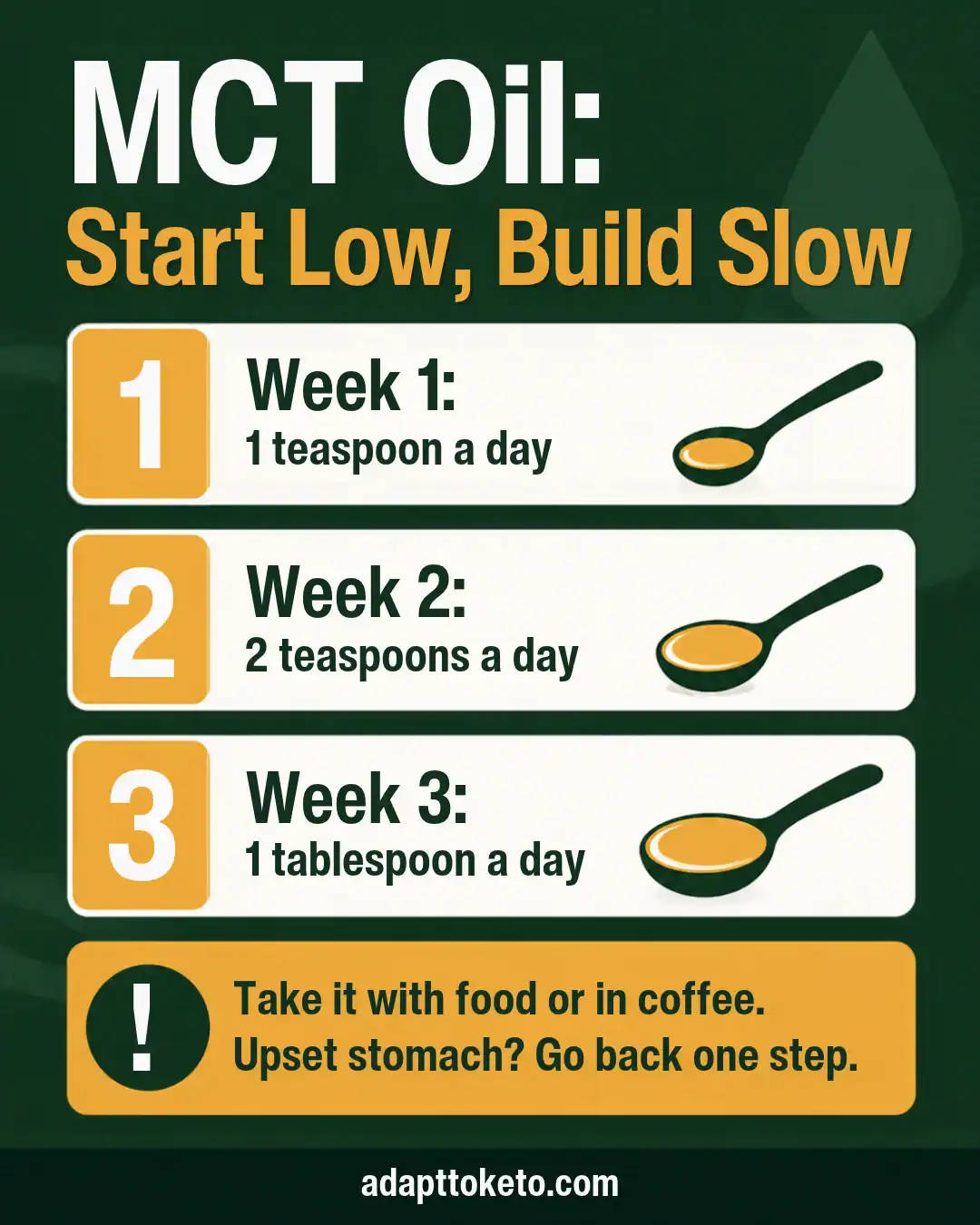
- Start with 1 teaspoon or less. Build up by about a teaspoon a week, or half a teaspoon if your stomach is sensitive.
- Take it with food or in coffee. WebMD notes that taking MCTs with food can help reduce side effects. Without food the ketone rise is larger, but so is the chance of cramps (St-Pierre et al., 2019).
- Split larger amounts. Above 1 tablespoon a day, spread it over two or three meals. The 2021 review lists about 15 to 20 g of C8 per dose as an upper range.
- Blend it. Blending MCT oil into coffee or a shake emulsifies it, which the review suggests may also reduce side effects.
Looking for ideas? Our guide to what a keto breakfast looks like has plenty of meals that pair well with a spoonful of MCT oil, and our comparison of collagen vs MCT oil explains how the two popular coffee add-ins differ.
Common mistakes with MCT oil
- Starting with a full tablespoon or more. This is the most common cause of cramps and urgent bathroom trips.
- Adding it on top of every meal. Three tablespoons a day is close to 400 calories. Count it in your macros.
- Using coconut oil and expecting the same effect. Coconut oil is mostly lauric acid and raises ketones much less than C8.
- Taking it only on an empty stomach from day one. Start with food, then experiment once your dose feels easy.
When to see a doctor
Talk to a doctor before adding MCT oil or starting keto if you take medication for diabetes, blood pressure or a heart condition, if you have liver or kidney disease, or if you are pregnant or breastfeeding. WebMD advises telling your provider about diabetes and liver problems before using MCTs, and notes that it is not known how MCTs could affect pregnancy (WebMD). Get medical help right away if you have severe belly pain, bloody stools, signs of an allergic reaction such as swelling or trouble breathing, or diarrhea or vomiting that will not stop.
Final verdict
For most keto dieters, the best MCT oil is a pure C8 oil from coconut, such as Sports Research Keto C8 or Bulletproof Brain Octane, because C8 gives the strongest ketone response. If you mainly want an easy fat for coffee, Nature’s Way Organic MCT Oil is a solid C8 and C10 blend, and Garden of Life MCT Powder is the gentlest way to start. Whatever you pick, start with a teaspoon, build up slowly with the planner above and count the calories in your daily macros.
Related articles
- Ketogenic Collagen vs. MCT Oil: Which is Better?
- What Does a Keto Breakfast Look Like?
- Ketone-IQ Review
- Best Blood Ketone Meters for Home Testing
- Keto Flu: Symptoms, Timeline and How to Fix It Fast
- Keto Macro Calculator
FAQ
Question: What is the best MCT oil for ketosis?
Answer: Pure C8 (caprylic acid) oil. Studies in healthy adults found that C8 raises blood ketones more than C8 and C10 blends, C10 or coconut oil.
Question: How much MCT oil should I take a day?
Answer: Start with 1 teaspoon or less and build up over a few weeks. Many labels list 1 tablespoon, 1 to 3 times a day, as the serving once you tolerate it. Use the planner above for a schedule that fits your stomach.
Question: Can I put MCT oil in my coffee?
Answer: Yes, that is the most popular way to use it. Blending it with the coffee gives a creamy drink and spreads the oil evenly, which is easier on your stomach.
Question: Is MCT oil the same as coconut oil?
Answer: No. MCT oil is made from parts of coconut or palm kernel oil and contains mostly C8 and C10. Coconut oil is mostly lauric acid (C12), which raises ketones much less.
Question: Why does MCT oil upset my stomach?
Answer: MCTs are absorbed quickly and large doses can cause cramps, nausea and diarrhea, especially if you are not used to them. Go back to a smaller dose, take it with food and build up more slowly.
This article is for general information and does not replace advice from your doctor or dietitian.